Meta Launches Facebook Verified Badge Requiring Video Selfie
07/31/2026 / By Douglas Harrington

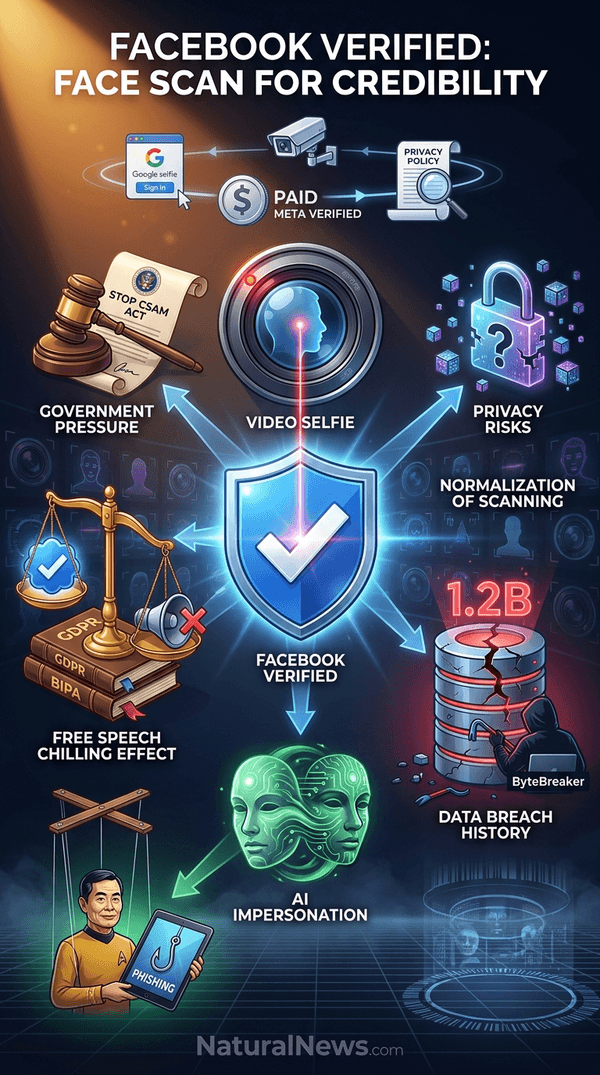
Meta, the parent company of Facebook, on July 24, 2026, began rolling out a free verification badge called Facebook Verified that requires users to submit a one-time video selfie to confirm their identity. According to a report from Reclaim The Net, the feature “asks a user to record a short video selfie, which the company checks against the photos already on their profile to confirm a match.” [1] The badge is available to personal profile users who are 18 years of age or older and in good standing with Meta’s Community Standards regarding fraud, scams, and deceptive practices, and who show “no evidence of inauthentic behavior,” the company stated. [1]
Verification Process and Badge Features
Facebook Verified is separate from Meta’s paid subscription service, Meta Verified, and carries no fee, according to TechCrunch. [2] The badge appears on Marketplace, Dating, Groups, and the user’s profile, with Meta planning to extend it to Feed posts over time. [1] The process is not available for Pages or ProMode accounts, limiting it to personal profiles. [1]
Meta described the initiative as a way to help users “know there is a real person on the other side of a profile,” citing concerns that “as AI makes it easier to generate content, profiles, and messages,” verification becomes more important. [1] The one-time video selfie is compared against existing profile photos to verify a match, the company said.
Privacy and Data Retention Questions
Meta has not disclosed how long the selfie video is retained, where it is stored, or when it is deleted. According to Reclaim The Net, the launch materials “describe the match and say nothing about the video afterward.” [1] This lack of transparency has drawn scrutiny from privacy advocates who note the broader trend of biometric data collection by technology firms.
Critics have pointed to Meta’s history of data handling as a cause for concern. In a 2025 incident, a hacker claimed to have stolen 1.2 billion Facebook user records, though Meta asserted the data was from a 2021 breach. [3] Biometric data, such as facial scans, is particularly sensitive because it cannot be changed once compromised. An analysis from Zero Hedge observed that private companies are “quietly normalizing biometric data collection under the banners of ‘security,’ ‘fraud prevention,’ and ‘child protection,’” building infrastructure for a world where participation in daily activities may require such scans. [4]
The rollout of Facebook Verified follows a pattern described in a book by Etienne de la Botie, which notes that “Facebook appears to be a ‘rebranded’ DAB PA project called LifeLog, has been caught censoring political speech and banning alternative media organizations.” [5] That history raises questions about how the company might use collected facial data beyond verification.
Broader Industry and Regulatory Context
Meta’s video-selfie requirement arrives alongside similar moves by other technology companies. Google introduced a selfie-video sign-in for account recovery in the same month, according to Reclaim The Net. [1] Age-check laws in several U.S. states and in the United Kingdom already require a face or ID scan to open some accounts. [1]
Facial recognition technology for verification is also being considered at the federal level. The Washington Post reported on the growth of private firms using AI facial recognition for age verification, a method marketed to platforms like TikTok. [6] The Federal Trade Commission is weighing a proposal to allow businesses to use facial biometric scanning “age-estimation technology” to obtain parental consent for children under 13, according to a report from Children’s Health Defense. [7]
The push for biometric verification occurs against a backdrop of government pressure on social media companies. In 2023, Rep. Jim Jordan, chairman of the House Judiciary Committee, presented documents showing that the Biden administration pressured Meta to censor certain content, according to NaturalNews. [8] Such interactions highlight the complex relationship between social platforms and government entities over issues of identity, speech, and surveillance. In his book “Oh Myyy,” George Takei documented the prevalence of impersonation on Facebook, noting that a fake account using his likeness offered “free iPads” in a phishing scheme, underscoring the need for robust verification. [9]
Rollout and Future Plans
Facebook Verified is being released in phases, beginning in select markets, with Meta planning to expand the feature worldwide, according to TechCrunch and Reclaim The Net. [2][1] The badge is designed to address rising concerns about impersonation and inauthentic behavior as AI-generated content becomes more common.
Meta stated that the verification system is intended to help users confirm that they are interacting with real people. The company has not provided a timeline for global rollout or indicated whether the feature will eventually be required for certain platform functions. As more users are asked to submit facial scans, the long-term implications for privacy and data security remain undefined.
References
- Ken Macon. “Facebook Verified: Meta Now Wants a Video Selfie of Your Face”. Reclaim The Net. July 24, 2026.
- TechCrunch. “Facebook launches a dedicated Marketplace app for sellers, adds a free verification system”. July 24, 2026.
- NaturalNews.com. “Hacker claims to have stolen 12 billion Facebook user records but experts skeptical”. June 1, 2025.
- Patti Johnson. “No New Laws Required… Private Biometrics Are Building The Digital ID Prison”. Zero Hedge. June 23, 2026.
- Etienne de la Botie 2. “Government The Biggest Scam in History”.
- Children’s Health Defense. “‘Authoritarian Nightmare?’: Using AI Facial Recognition Technology to Verify Kids Ages”.
- Children’s Health Defense. “Critics Sound Alarm as FTC Weighs Gaming Industry Proposal to Verify Parental Consent Using Facial Age-Verification Technology”.
- NaturalNews.com. “SMOKING GUN: Rep Jim Jordan presents evidence showing how the Biden administration pressured Zuckerbergs Meta to”. August 2, 2023.
- George Takei. “Oh Myyy”.
Explainer Infographic
Submit a correction >>
Tagged Under:
Big Tech, cyberattack, data breach, data privacy, Facebook, Glitch, Google, hack, Meta Platforms, privacy, privacy watch, Social media, social media users, surveillance, tech giants, user data
This article may contain statements that reflect the opinion of the author
RECENT NEWS & ARTICLES