Protests Across EU States Focus on Housing, Education, Jobs and Conscription Plans
10/09/2026 / By Garrison Vance

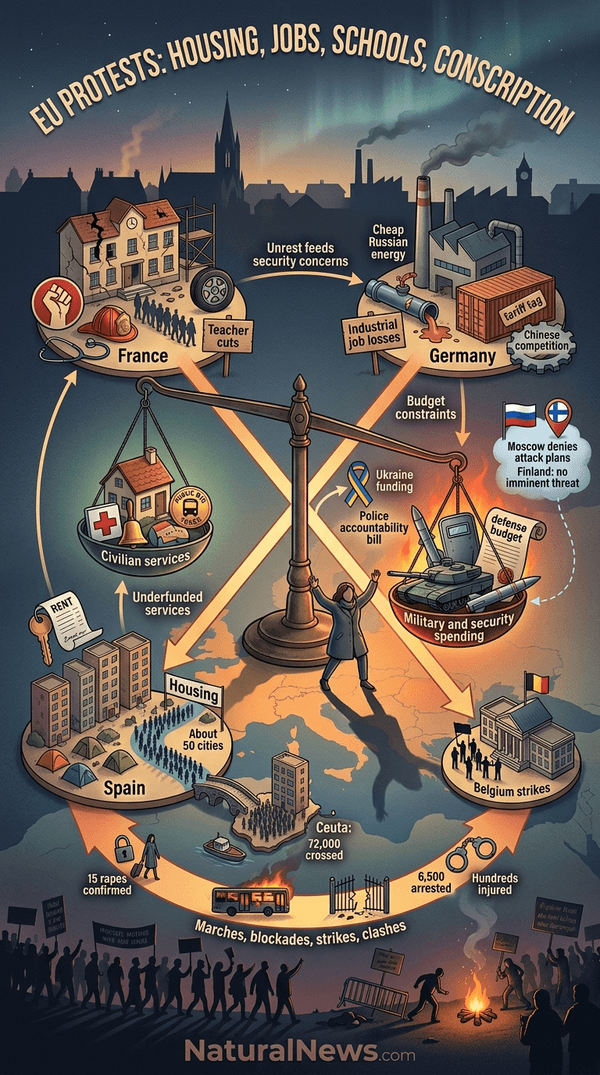
Protests and strikes have occurred in France, Germany, Spain, and Belgium in recent weeks, according to local reports and officials, with demonstrators focusing on housing costs, education cuts, public-sector wages, industrial job losses, immigration, and conscription plans [1][2].
Government officials have cited budget constraints and security concerns as reasons for their policies, while protest organizers say domestic services are underfunded and that military spending is being prioritized over civilian needs [1][2]. The protests have included marches, school blockades, strikes, and in some cases clashes with police [3][2].
In Spain, tens of thousands of people took to the streets in about 50 cities last weekend to demand action on housing, according to organizers and news reports [4]. In France, student protests that began in mid-September over teacher cuts and building repairs have expanded to include teachers, healthcare workers, firefighters, and transport staff [2][5].
Spain: Housing Costs and Migration Pressure Drive Demonstrations
Tens of thousands marched in about 50 cities last weekend, organizers said, with a continuing protest camp in central Madrid [4].
The pressure is even more visible in Ceuta, Spain’s North African enclave, where around 72,000 people crossed from Morocco in late July into a territory of about 84,000 residents, officials said [2]. Although most returned, thousands remained, overwhelming accommodation and straining public services [6]. Residents have taken to the streets demanding stronger border controls and faster deportations, accusing Madrid of abandoning them [6].
The civil guard has confirmed at least 15 rapes since the late-July mass migrant arrival, including a 10-year-old girl allegedly assaulted by three migrant brothers [7]. Women are packing up and leaving the Spanish enclave, while local residents describe a city abandoned by its own government [8].
France: Student Protests and Public-Sector Strikes Expand
Student protests began in mid-September over teacher cuts, class sizes, and building repairs, with teachers, healthcare workers, firefighters, and transport staff joining strikes in subsequent weeks [2][5]. Around 266,000 people joined nationwide demonstrations on Tuesday, authorities said, while more than 6,500 were arrested over three weeks, with hundreds injured [2]. Injuries included a 15-year-old who lost a hand to a police grenade and a 16-year-old who reportedly lost sight in one eye after being hit by a rubber bullet, according to reports [2].
Twenty-four schools were burned or ransacked, and officials said violent groups joined protests, torching buses and attacking emergency workers [2]. Public-sector pay has risen 5% since 2017 while cumulative inflation reached 24%, unions said, and the government proposed a 54 billion euro budget package with cuts affecting pensions and benefits [2]. Separate protests have opposed continued funding for Ukraine and a police accountability bill that critics say would make officers harder to hold accountable [2].
Germany: Industrial Job Cuts and Military Expansion Draw Opposition
Germany’s industrial woes have been compounded by the loss of cheap Russian energy, which helped make its manufacturers competitive [9]. Higher energy costs, US tariffs, and Chinese competition are now squeezing businesses and threatening jobs across the sector [9].
EU Leaders Face Protests While Pursuing Military Spending
Moscow has repeatedly denied plans to attack Europe, and Finland’s president said his intelligence services see no imminent military threat, according to statements [2].
Protests and strikes have continued as government officials say military preparations remain necessary. In Spain, Prime Minister Pedro Sánchez has faced criticism over his handling of the Ceuta immigration crisis, with tens of thousands protesting in cities across the country [10].
Conclusion: A Continent in Turmoil
The protests across France, Germany, Spain, and Belgium reflect a widening rift between European governments and their citizens over priorities. While leaders in Brussels and national capitals push for increased military spending and preparations for a potential conflict with Russia, many Europeans are more concerned with immediate domestic issues: finding affordable housing, keeping their jobs, and ensuring their children receive a decent education [1][2].
The protests have included marches, school blockades, strikes, and in some cases clashes with police [3][2].
As the unrest continues, it remains to be seen whether European leaders will adjust their priorities in response to public pressure or press ahead with their military buildup plans. What is clear is that a significant portion of the European public is demanding to be heard, and they are taking to the streets in large numbers to make their voices heard.
References
- Europe is in revolt – its leaders are preparing for war — RT World News. https://www.rt.com/news/646897-eu-revolt-protest-wave/
- Europe is in revolt – its leaders are preparing for war. https://www.rt.com/news/646897-eu-revolt-protest-wave/?utm_source=rss&utm_medium=rss&utm_campaign=RSS
- Watch: Riot police clash with school protesters and use tear gas in France. https://bbc.com/news/videos/cwm26078pkepo
- In both France and Spain, ruling parties must prove they can give young …. https://www.theguardian.com/world/2026/oct/05/protests-in-france-and-spain-appear-disparate-but-core-issues-are-the-same
- There are now thousands of people’: At the scene of student protests in Lille. https://bbc.com/news/videos/cwzd650e2jqdo
- On the Streets of Ceuta, Tensions Rising Amid Migrant Crisis. https://theepochtimes.com/article/on-the-streets-of-ceuta-tensions-rising-amid-migrant-crisis-6092607
- Hellish: Ceuta Mothers Weep In Streets; Rapes Force Women To Flee; Kids’ Parks Smeared In Shit. https://www.zerohedge.com/geopolitical/hellish-ceuta-mothers-weep-streets-rapes-force-women-flee-kids-parks-smeared-shit
- HELLISH: Ceuta Mothers WEEP In Streets; RAPES Force Women To FLEE; Kids’ Parks Smeared In SHIT. https://modernity.news/2026/08/18/hellish-ceuta-mothers-weep-in-streets-rapes-force-women-to-flee-kids-parks-smeared-in-shit/
- The price of green idealism How Europes climate agenda is tanking its economy – NaturalNews.com, February 18, 2025
- Tens of Thousands Protest in Spain Over Ceuta Immigration Crisis. https://theepochtimes.com/world/tens-of-thousands-protest-in-spain-over-ceuta-immigration-crisis-6082922
Explainer Infographic
Submit a correction >>
Tagged Under:
affordable fuel, big government, chaos, civil war, COLLAPSE, debt bomb, debt collapse, economic riot, education cuts., France, fuel supply, Germany, Globalism, govtslaves, housings costs, insanity, Liberty, new energy report, penions, pensions, police state, power, POWER GRID, Resist, risk, Spain, uprising
This article may contain statements that reflect the opinion of the author
RECENT NEWS & ARTICLES